

Last updated: November 2026. For physiotherapists, chiropractors, massage therapists, osteopaths and gym owners in Australia.
If you run a clinic or recovery studio, a handheld vibration tool has to earn its place: it needs to save time in the treatment room, be comfortable for clients, survive all-day use and keep working when the battery runs low mid-session. This guide looks at the Rapid Release Pro3 from a practice owner’s point of view, compares it with the ProAm, and shows how to work out whether it pays for itself in your clinic.
Quick answer: The Pro3 is the clinic model. It runs at around 10,000 vibrations per minute with a short stroke, has five built-in treatment surfaces so there is nothing to swap between clients, and comes with two rechargeable batteries and a 2-year warranty. Choose the ProAm instead if you mainly need a lighter, portable unit for mobile or sideline work. Clinics can ask MeWellness for trade pricing.
Why clinics choose the Pro3
- Comfortable on more of the body. The short, fast stroke is generally comfortable around joints and bony areas where a massage gun is not, so you can use one tool across more of a session.
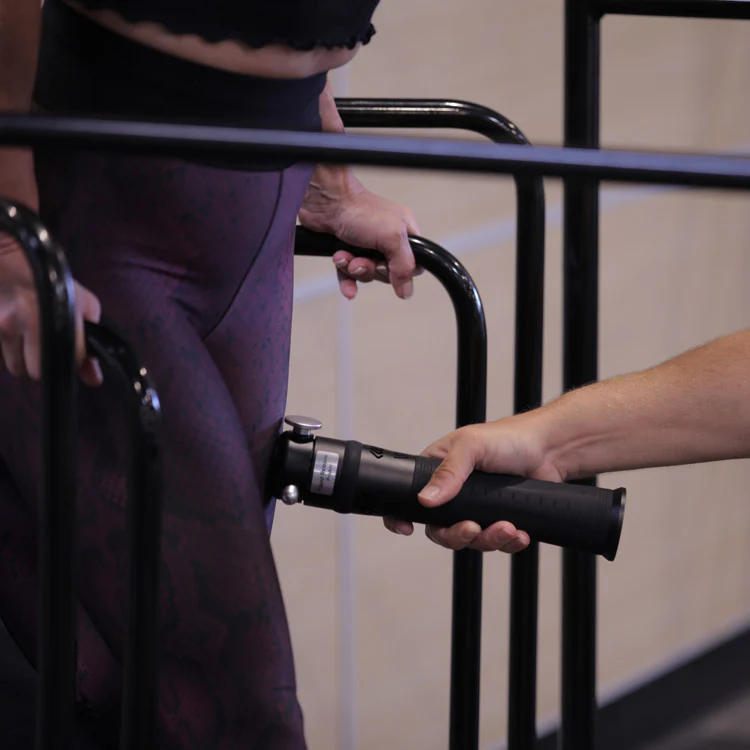
- No attachment swapping. Five treatment surfaces are built into the head, so you move between broad muscle work and precise spots without stopping.
- Two batteries. Swap a charged battery in and keep going through a full day of appointments.
- Linear, easy-to-hold design. Easier on your wrists across back-to-back sessions and good for reaching the back, shoulders and legs.
- 2-year warranty with local support from an Australian supplier.

How practitioners use it in a session
Rapid Release is used as an adjunct to hands-on work, not a replacement for clinical judgement. Common ways clinics build it into appointments:
- Warm-up before manual therapy: 1 to 2 minutes over the area to relax muscle guarding before hands-on work or an adjustment.
- Soft tissue work around joints: using the smaller surfaces around the shoulder, elbow, knee and foot.
- Recovery add-ons: a short, bookable vibration add-on alongside compression boots or other recovery services.
- Home-care recommendations: clients who like the feel can continue at home with a ProAm or Traveler between visits.
Keep claims to clients within wellness and comfort language: muscle relaxation, tension relief and recovery. Avoid promising to treat specific conditions.
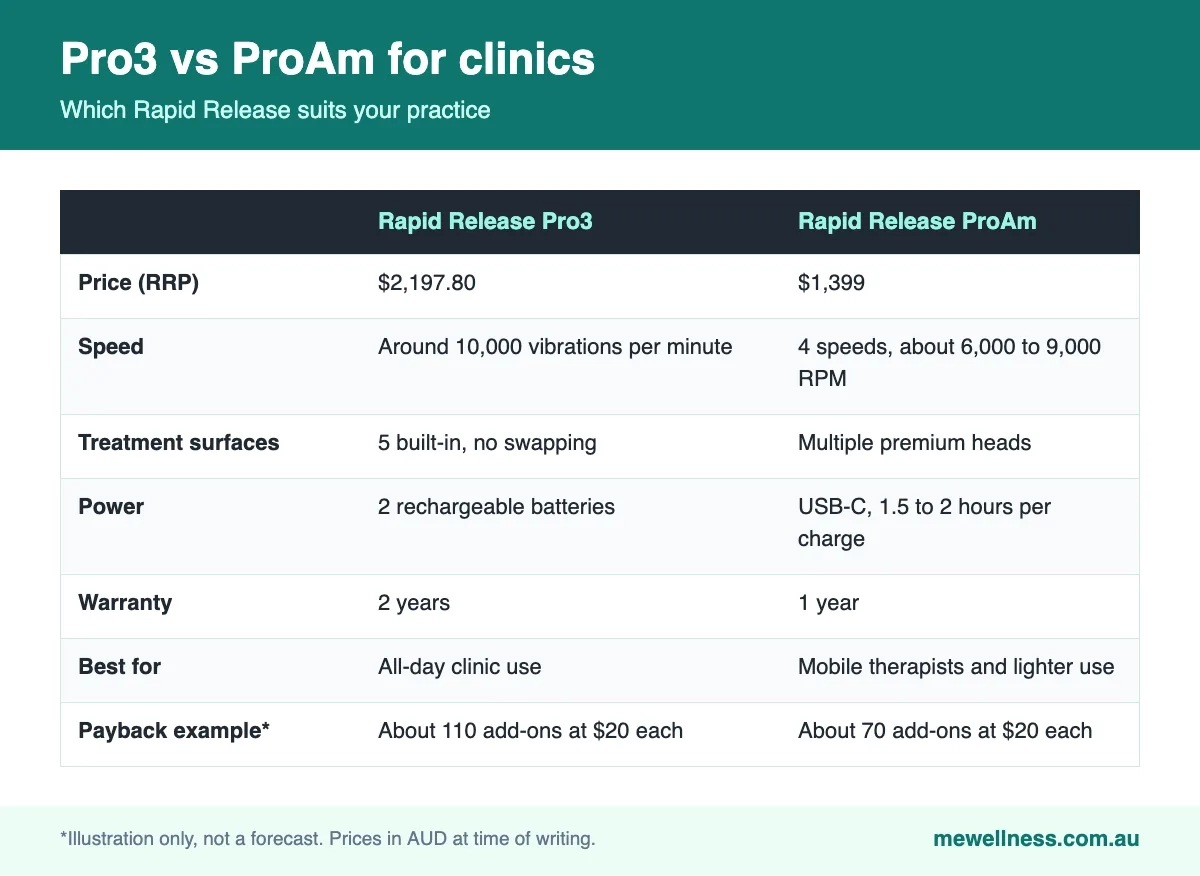
Pro3 vs ProAm for clinic use
| Rapid Release Pro3 | Rapid Release ProAm | |
|---|---|---|
| Price (RRP) | $2,197.80 | $1,399 |
| Speed | Around 10,000 vibrations per minute | 4 speeds, about 6,000 to 9,000 RPM |
| Treatment surfaces | 5 built-in | Multiple premium heads |
| Power | 2 rechargeable batteries and charger | USB-C, 1.5 to 2 hours per charge |
| Warranty | 2 years | 1 year |
| Best for | All-day clinic use | Mobile therapists, sideline and lighter use |
Will it pay for itself? A simple way to check
Every clinic is different, so run your own numbers. Here is a simple worked example you can adapt. The figures below are an illustration only, not a forecast.
- Device cost: $2,197.80
- Say you offer a 10-minute vibration add-on at $20
- Break-even: $2,197.80 ÷ $20 = about 110 add-ons
- At 5 add-ons a week, that is about 22 weeks. At 10 a week, about 11 weeks.
Some clinics do not charge separately and instead use the device to make sessions more efficient or to improve the client experience. In that case, the value shows up in rebookings and referrals rather than a line item.
Buying for your clinic
- Trade pricing: physio, chiro, massage and allied health clinics, gyms and recovery studios can contact MeWellness for trade pricing.
- Local stock and support: shipped Australia-wide with local after-sales help.
- Mixing models: many clinics buy a Pro3 for the treatment room and recommend the ProAm or Traveler for clients at home.
For usage tips you can share with clients, see how to use Rapid Release.
Frequently asked questions
Is the Rapid Release Pro3 suitable for continuous clinic use?
Yes. It is the professional model and comes with two rechargeable batteries so you can swap one in while the other charges.
What is the difference between the Pro3 and the Pro3+?
Pro3+ is the latest version of the professional model sold in some markets. Ask us which version is currently in stock in Australia.
Can I claim it as a business expense?
Equipment used in your practice is usually a business expense, but check with your accountant about how it applies to you.
Do you offer trade or bulk pricing?
Yes. Clinics, gyms and recovery studios can contact us for trade pricing.
Rapid Release devices are sold as wellness and recovery tools and are not intended to diagnose, treat, cure or prevent any medical condition. Prices are MeWellness RRP in AUD at the time of writing.