


Last updated: November 2026. General wellness information only. Rapid Release devices are for muscle relaxation and recovery and are not a substitute for professional medical advice.
Rapid Release devices feel very different from a massage gun. Instead of a long, pounding stroke, they use a very fast, very short stroke, which is why many people find them comfortable on areas a massage gun would hurt, such as around joints and bony spots. This guide explains how to get the most out of a Rapid Release Pro3 or ProAm: which speed to use, which treatment surface, how long to spend on each area, and when not to use it.
Quick answer: Start on a lower speed, keep the device moving slowly over the area, and spend about 2 to 5 minutes per muscle group. Use broad surfaces on big muscles and the smaller tips on precise spots. Do not press hard: let the vibration do the work. Avoid open wounds, recent injuries, numb areas and the front of the neck, and check with a health professional first if you are pregnant, have a pacemaker or other implant, or have a blood clotting condition.
How Rapid Release differs from a massage gun
| Rapid Release | Typical massage gun | |
|---|---|---|
| Motion | High-frequency, short-stroke vibration | Longer percussive stroke |
| Speed | Pro3 around 10,000 per minute; ProAm 6,000 to 9,000 RPM | Usually 1,750 to 3,200 per minute |
| Feel | Buzzing, smooth, comfortable over bony areas | Thumping, best on fleshy muscle |
| Attachments | Built-in treatment surfaces, no swapping | Swap-on heads |
For a full head-to-head, read Rapid Release vs Theragun.
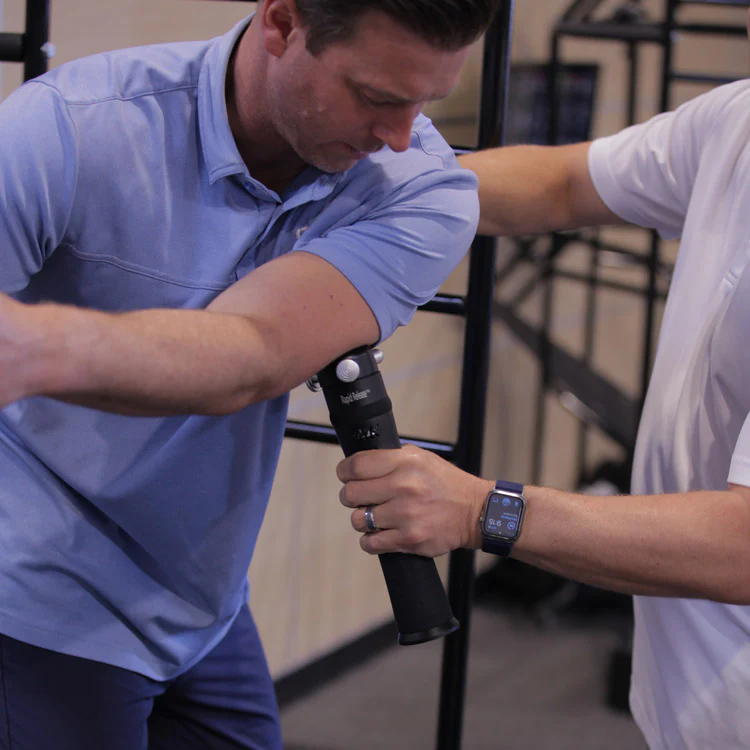
Step by step: a basic session
- Pick the area. Work on one muscle group at a time, for example calves, then hamstrings.
- Choose a surface. Use a broad surface for large muscles and a smaller tip for precise spots such as around the shoulder blade or the sole of the foot.
- Start low. On the ProAm, begin at the lowest speed. On the Pro3, start with light contact.
- Keep it moving. Glide slowly along the muscle. Pause for a few seconds on tight spots, then move on.
- Use light pressure. Pressing hard does not help and makes the vibration feel harsher.
- Time it. Around 2 to 5 minutes per muscle group is plenty for most people.
- Move afterwards. Gentle stretching or a few range-of-motion movements helps you notice the difference.
Speed and time guide by body area

| Area | ProAm speed | Surface | Time |
|---|---|---|---|
| Calves, quads, hamstrings, glutes | Medium to high | Broad | 3 to 5 min each |
| Upper back and shoulders | Medium | Broad, then a smaller tip | 3 to 4 min |
| Back of the neck and upper traps | Lowest | Softer surface | 1 to 2 min |
| Forearms, wrists and hands | Low to medium | Smaller tip | 2 to 3 min |
| Soles of the feet | Medium | Smaller tip | 2 to 3 min |
The ProAm has four speeds (about 6,000 to 9,000 RPM). The Pro3 runs at around 10,000 vibrations per minute, so you control intensity mainly with contact pressure and which surface you use.
When to use it
- Before training: 1 to 2 minutes per area as part of a warm-up.
- After training: 2 to 5 minutes per worked muscle group to help you relax and recover.
- After long days at a desk, driving or on your feet, for neck, shoulders, lower back and feet.
- Daily use is fine for most people. Keep sessions short and comfortable.

When not to use it
- Over open wounds, cuts, rashes, bruises or recent fractures
- On a fresh injury with swelling or heat
- On areas with numbness or reduced sensation
- On the front of the neck, the eyes or directly over the spine with heavy pressure
- If you are pregnant, have a pacemaker or other implanted device, a blood clotting condition, or any serious health condition, unless your health professional has said it is fine
Pro3, ProAm or Traveler?
- Rapid Release Pro3 ($2,197.80): the professional model. Around 10,000 vibrations per minute, five built-in treatment surfaces, two rechargeable batteries and a 2-year warranty. Best for clinics and heavy users.
- Rapid Release ProAm ($1,399): four speeds (about 6,000 to 9,000 RPM), USB-C charging and 1.5 to 2 hours per charge. Best for active people and therapists who travel.
- Rapid Release Traveler ($699): compact, three gentler speeds (about 4,000 to 6,000 RPM), made for the face, neck, hands and small areas.
Still deciding? See Which Rapid Release is right for you?
Frequently asked questions
How long should I use Rapid Release on one area?
Around 2 to 5 minutes per muscle group is enough for most people. Shorter on sensitive areas such as the neck.
Can I use Rapid Release every day?
Yes, most people can use it daily for warm-ups and recovery. Keep sessions comfortable and stop if anything feels painful.
Does Rapid Release hurt?
It should not. The short stroke usually feels like a strong buzz. If it is uncomfortable, lower the speed, use a softer surface or reduce pressure.
Can I use it over bony areas?
The short stroke is generally comfortable around joints and bony areas, which is one reason people choose it over a massage gun. Use light pressure and a lower speed.
Prices are MeWellness RRP in AUD at the time of writing. Running a clinic? Read Rapid Release Pro3 for clinics or ask about trade pricing.