



Last updated: November 2026. This article is general information, not medical advice. Speak with your GP, endocrinologist or physiotherapist before starting any bone health program.
If you have been told you have osteopenia or osteoporosis, two drug-free names come up a lot in Australia: Marodyne LiV, a low-intensity vibration platform you use at home, and OsteoStrong, a franchise of centres that use machines for weekly “osteogenic loading” sessions.
They are often mentioned together, but they work in very different ways. This guide compares how each one works, what the research says, safety, time and cost, so you can talk it through with your doctor.
Quick answer: Marodyne LiV is a gentle, 10-minute daily home therapy using very low-intensity vibration (0.4g at 30 Hz). It is listed on the ARTG as a Class IIa medical device. OsteoStrong is a once-a-week, 10 to 15 minute supervised session where you push against machines with high, brief force. LiV suits people who want something gentle and daily at home, including those who cannot do strenuous exercise. OsteoStrong suits people who can safely produce high forces and prefer a weekly coached visit. Neither replaces medication or a doctor’s plan.
How Marodyne LiV works
Marodyne LiV is a small platform you stand on for 10 minutes a day. It sends gentle vertical vibration up through the feet at 30 Hz and 0.4g, which is far lower than the gym-style vibration plates sold for fitness. The idea, developed from Dr Clinton Rubin’s research, is that bone and muscle cells respond to small, frequent mechanical signals, similar to the constant tiny muscle contractions that happen when we stand and move.
- Where: at home (or in a clinic)
- How often: 10 minutes, once a day
- Effort: none. You stand still on the platform
- Regulatory status: listed on the Australian Register of Therapeutic Goods as a Class IIa medical device (ARTG 317506)

How OsteoStrong works
OsteoStrong runs centres where members do a short circuit on four machines once a week. Each machine puts you in a strong, stable position (for example a leg press or chest press position) and you push as hard as you safely can for a few seconds. The company calls this osteogenic loading: briefly loading the skeleton with several times your body weight, based on the principle that bone adapts to the loads placed on it.
- Where: at an OsteoStrong centre
- How often: one session a week, about 10 to 15 minutes
- Effort: short, maximal pushes under supervision
- Cost model: ongoing membership (check your local centre for current pricing)
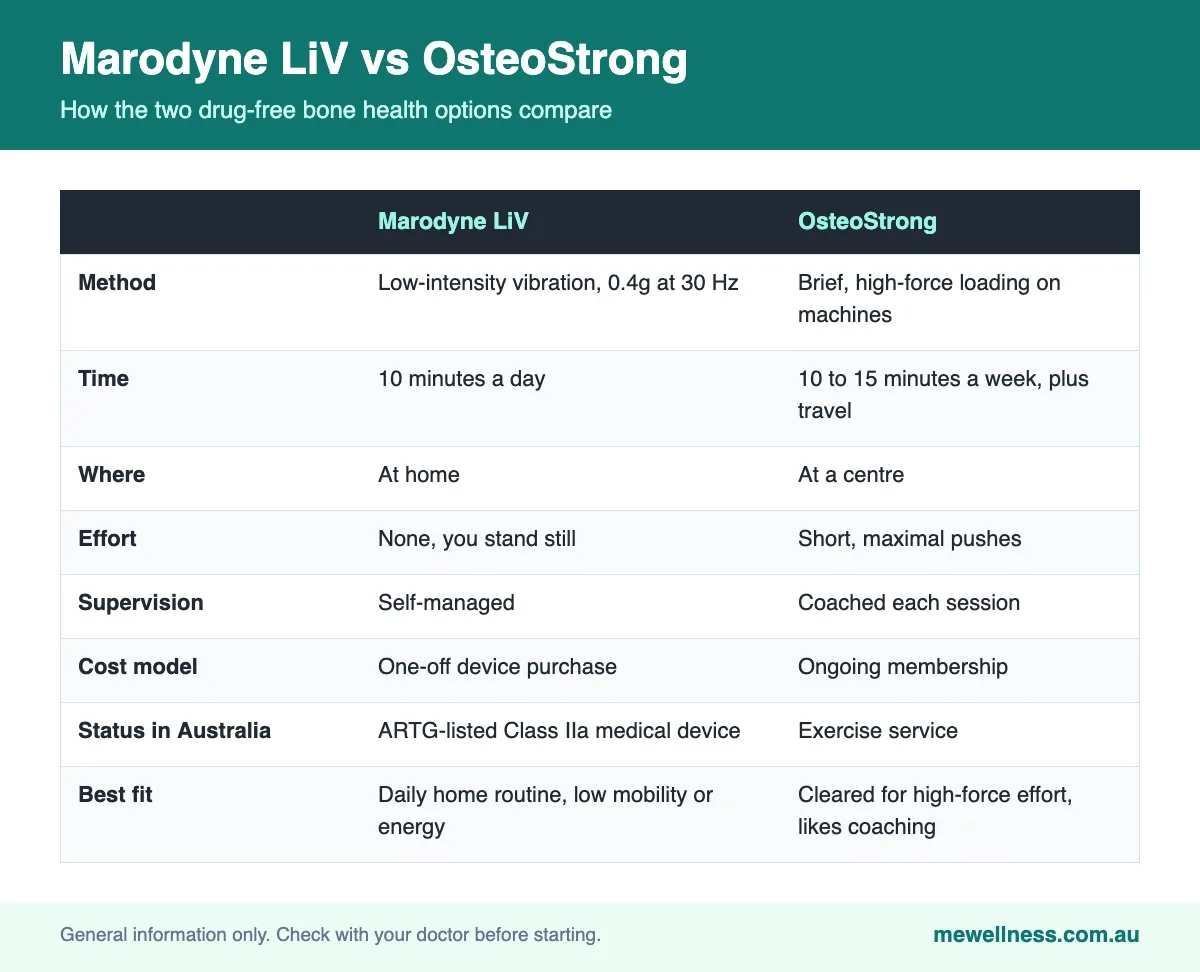
Side-by-side comparison
| Factor | Marodyne LiV | OsteoStrong |
|---|---|---|
| Method | Low-intensity vibration (0.4g, 30 Hz) | High-force, brief loading on machines |
| Time | 10 min a day | 10 to 15 min a week, plus travel |
| Location | Home | Centre |
| Physical effort | None | Maximal short efforts |
| Supervision | Self-managed | Coached each session |
| Cost model | One-off device purchase | Ongoing membership |
| Regulatory status in Australia | ARTG-listed Class IIa medical device | Exercise service using strength equipment |
| Best fit | Frail, less mobile or time-poor people who want a daily home routine | People cleared for high-force effort who like a weekly coached visit |
What does the research say?
Both approaches have supporters and both have limits in the evidence, so it is worth being clear about what is and is not known.
Low-intensity vibration
- A 2023 systematic review and meta-analysis of randomised trials in postmenopausal women (Osteoporosis International) concluded that whole-body vibration at high frequency (around 30 Hz), low magnitude (around 0.3g) and a high cumulative dose can be recommended to improve lumbar spine bone mineral density.
- Not every trial is positive. A 12-month randomised trial in Toronto (Annals of Internal Medicine, 2011) found no change in bone density with low-magnitude vibration in postmenopausal women with osteopenia who were also taking calcium and vitamin D.
- Consistency matters. The positive findings are tied to a high total dose, which is why daily use is recommended.
Osteogenic loading
- OsteoStrong points to published studies of osteogenic loading in postmenopausal women, including a Greek study of brief, high-intensity loading in osteoporosis.
- Independent commentators note that the studies are small and that more rigorous, independent trials are needed before strong claims can be made.
The honest summary: neither option should be seen as a standalone fix. Both are best viewed as additions to a plan that includes your doctor’s advice, any prescribed medication, calcium and vitamin D, and safe exercise.
Safety and who should check first
Marodyne LiV is designed to be very gentle, but you should get advice first if you have had recent surgery or implants, have a pacemaker, current blood clots, are pregnant, or have dizziness, seizures or retinal conditions.
OsteoStrong involves pushing with high force. If you have severe osteoporosis, previous vertebral fractures, uncontrolled blood pressure, hernias or heart conditions, ask your doctor whether maximal efforts are safe for you before joining.
Which one should you choose?
- Choose Marodyne LiV if you want a daily routine at home, have limited mobility or energy, cannot do strenuous exercise, live far from a centre, or prefer a one-off purchase.
- Choose OsteoStrong if you are cleared for high-force efforts, enjoy a coached session and are happy with an ongoing membership.
- Some people do both, with LiV at home daily and loading or resistance training weekly. Ask your health professional what fits your bone density results and fracture risk.
Talk to us about Marodyne LiV
MeWellness supplies Marodyne LiV in Australia with local support and can help with NDIS invoicing where eligible. See Marodyne LiV and enquire about pricing, or read our Marodyne LiV buying guide first.
Frequently asked questions
Is Marodyne LiV the same as a gym vibration plate?
No. Gym plates often run at several g of acceleration for fitness training. Marodyne LiV runs at 0.4g, a much gentler signal designed for bone and muscle health, and is listed on the ARTG as a Class IIa medical device.
How long until I see results with either option?
Bone changes slowly. Bone density is usually re-checked with a DXA scan after 12 months or more, so both options need long-term consistency.
Can I use Marodyne LiV while taking osteoporosis medication?
LiV is designed to complement other treatments, but always check with your prescribing doctor before adding any therapy.
Is OsteoStrong suitable if I have had a fracture?
That depends on the fracture and your current bone health. Get clearance from your doctor first, because sessions involve maximal efforts.
Sources: Osteoporosis International (2023) systematic review and meta-analysis of whole-body vibration in postmenopausal women; Slatkovska et al., Annals of Internal Medicine (2011); TGA ARTG entry 317506; OsteoStrong published material. Related reading: Vibration plate for osteoporosis and Is Marodyne LiV worth it?