



Marodyne LiV Australia: Where to Buy, Price, Used Units and What the Research Says
Last updated: November 2026. This article is general information, not medical advice.
Marodyne LiV is not something you can pick up at a chemist or a sports store, and searching for it in Australia brings up overseas prices, second-hand listings and very mixed information. This guide covers where to buy it in Australia, what to check before buying a used unit, what independent reviewers and research say, and the questions to ask before you commit.
Quick answer: In Australia, Marodyne LiV is supplied as an ARTG-listed Class IIa medical device (ARTG 317506). Buy from an authorised Australian supplier so you get the correct power supply, local warranty and support. Pricing is quoted on enquiry, and NDIS participants may be able to claim it where it fits their plan. Be cautious with second-hand units from overseas.
What you are actually buying
- A low-intensity vibration platform that delivers 0.4g at 30 Hz
- Designed for 10 minutes of use a day, standing still on the platform
- Automatic sessions and quiet enough for a lounge room or bedroom
- Supplied with the device, a power supply, a travel bag and instructions
- Listed on the Australian Register of Therapeutic Goods as a Class IIa medical device
That last point matters. A Class IIa listing means the device has been through the TGA's process for that intended purpose. Generic vibration plates sold for fitness are not the same thing, even if they look similar.

Where to buy Marodyne LiV in Australia
Marodyne LiV is supplied in Australia through authorised distributors rather than general retailers. Buying locally gives you:
- The right power supply for Australian sockets and voltage
- Local warranty and support if anything goes wrong
- Guidance on setup, including where to place the platform and how to stand on it
- NDIS invoicing where the device suits a participant's plan
MeWellness supplies Marodyne LiV Australia-wide. Enquire about current pricing and availability.
How much does Marodyne LiV cost?
Pricing in Australia is quoted on enquiry, because it can depend on packages, clinic purchases and NDIS invoicing. When comparing prices online, keep in mind:
- UK and US prices often exclude shipping, import duties, GST and an Australian power supply.
- Overseas units may not be covered by an Australian warranty.
- The ongoing cost is close to nothing. There is no membership, consumables or subscription, so the price is a one-off over years of daily use.
For a longer look at value over time, read Is Marodyne LiV worth it?
Should you buy a used Marodyne LiV?
Second-hand units do come up. They can save money, but check these points first:
- Age and usage: ask how old it is and how often it was used.
- Origin: a unit bought overseas may have the wrong power supply and no local warranty.
- Proof of purchase: without it, warranty claims are unlikely to be accepted.
- Condition: look for damage to the platform surface, cable or power supply.
- Support: ask whether the original supplier will still help with setup and questions.
If any of these are unclear, a new unit from an Australian supplier is usually the safer choice for a device you plan to use every day for years.

What do independent reviews and research say?
We do not publish made-up reviews. Here is what you can check for yourself:
- Independent physiotherapist reviews, such as MelioGuide's, describe Marodyne LiV as a useful supplement to exercise for people over 50, especially when weather, injury or mobility limits walking. They also stress that it does not replace an exercise program.
- Research on low-intensity vibration is promising but mixed. A 2023 meta-analysis in Osteoporosis International supported high-frequency, low-magnitude vibration with a high cumulative dose for lumbar spine bone density in postmenopausal women. A 12-month Canadian trial published in 2011 found no change in bone density.
- Consistency is the common thread. The positive results come from regular, long-term daily use.
Read more in our guide to vibration plates for osteoporosis.
Marodyne LiV alternatives
- Weight-bearing and resistance exercise remains the foundation of bone health. Ask a physiotherapist or exercise physiologist for a safe program.
- OsteoStrong offers weekly supervised high-force loading sessions. See our Marodyne LiV vs OsteoStrong comparison.
- High-intensity gym vibration plates are not designed for people with low bone density and may not be suitable. Check with your doctor first.

Questions to ask before you buy
- Has my doctor or physiotherapist said vibration therapy is suitable for me?
- Do I have any reason to get advice first, such as recent surgery or implants, a pacemaker, blood clots, pregnancy, seizures or retinal conditions?
- Can I realistically use it for 10 minutes every day?
- Am I eligible to claim it through the NDIS?
- Will I get an Australian warranty and local support?
Frequently asked questions
Is Marodyne LiV TGA approved?
Marodyne LiV is included on the Australian Register of Therapeutic Goods as a Class IIa medical device (ARTG 317506).
Can I buy Marodyne LiV on Amazon in Australia?
It is supplied in Australia through authorised distributors. Units from overseas marketplaces may not include an Australian power supply or local warranty.
Can I claim Marodyne LiV through the NDIS?
Some participants can, where the device is reasonable and necessary under their plan. Talk to your plan manager or support coordinator, and ask us about NDIS invoicing.
How long do I need to use it each day?
The recommended routine is 10 minutes a day.
Sources: TGA ARTG entry 317506; Osteoporosis International (2023) systematic review and meta-analysis; Slatkovska et al., Annals of Internal Medicine (2011); MelioGuide independent Marodyne LiV review.

Marodyne LiV vs OsteoStrong: Which Bone Health Option Suits You? (Australia)
Last updated: November 2026. This article is general information, not medical advice. Speak with your GP, endocrinologist or physiotherapist before starting any bone health program.
If you have been told you have osteopenia or osteoporosis, two drug-free names come up a lot in Australia: Marodyne LiV, a low-intensity vibration platform you use at home, and OsteoStrong, a franchise of centres that use machines for weekly "osteogenic loading" sessions.
They are often mentioned together, but they work in very different ways. This guide compares how each one works, what the research says, safety, time and cost, so you can talk it through with your doctor.
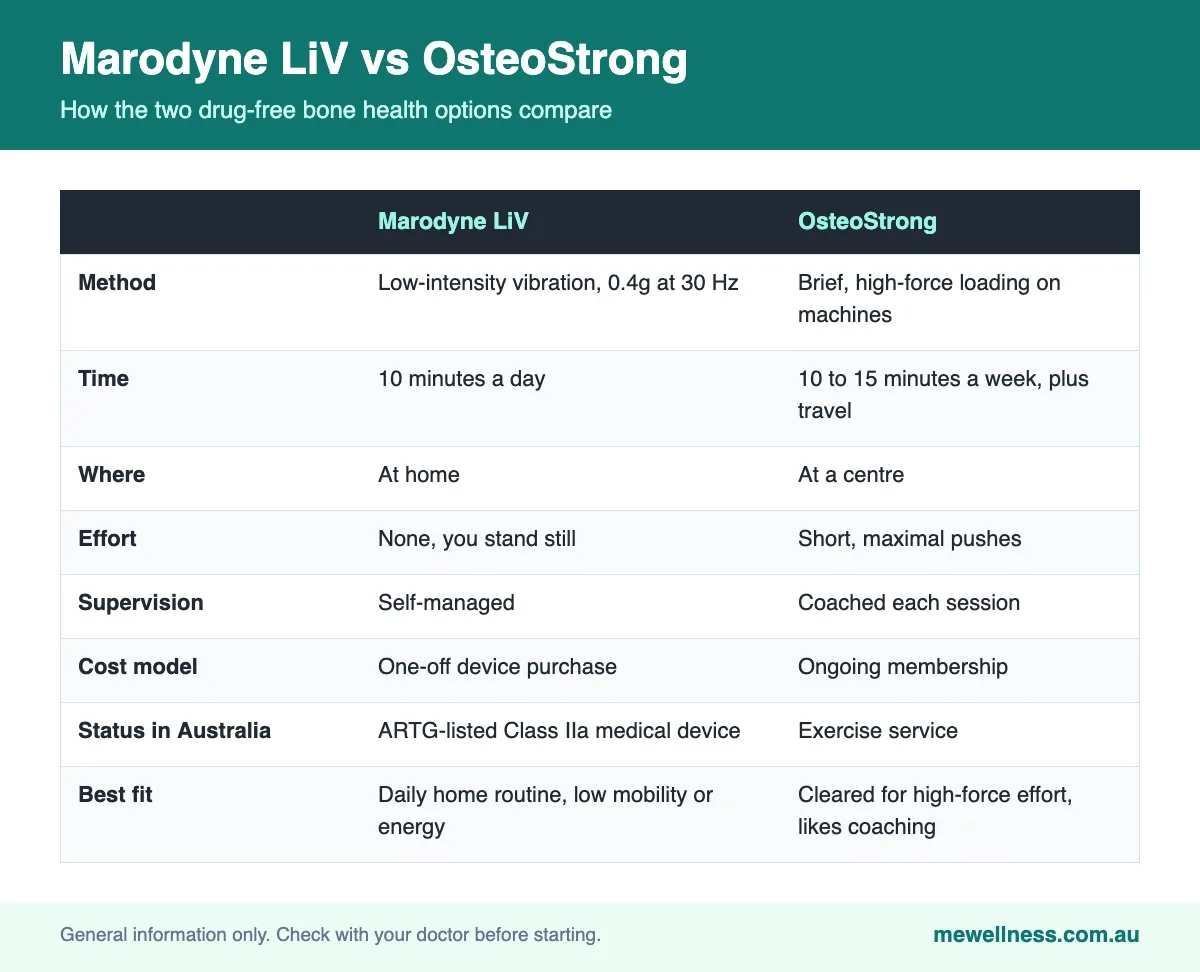
Quick answer: Marodyne LiV is a gentle, 10-minute daily home therapy using very low-intensity vibration (0.4g at 30 Hz). It is listed on the ARTG as a Class IIa medical device. OsteoStrong is a once-a-week, 10 to 15 minute supervised session where you push against machines with high, brief force. LiV suits people who want something gentle and daily at home, including those who cannot do strenuous exercise. OsteoStrong suits people who can safely produce high forces and prefer a weekly coached visit. Neither replaces medication or a doctor's plan.
How Marodyne LiV works
Marodyne LiV is a small platform you stand on for 10 minutes a day. It sends gentle vertical vibration up through the feet at 30 Hz and 0.4g, which is far lower than the gym-style vibration plates sold for fitness. The idea, developed from Dr Clinton Rubin's research, is that bone and muscle cells respond to small, frequent mechanical signals, similar to the constant tiny muscle contractions that happen when we stand and move.
- Where: at home (or in a clinic)
- How often: 10 minutes, once a day
- Effort: none. You stand still on the platform
- Regulatory status: listed on the Australian Register of Therapeutic Goods as a Class IIa medical device (ARTG 317506)

How OsteoStrong works
OsteoStrong runs centres where members do a short circuit on four machines once a week. Each machine puts you in a strong, stable position (for example a leg press or chest press position) and you push as hard as you safely can for a few seconds. The company calls this osteogenic loading: briefly loading the skeleton with several times your body weight, based on the principle that bone adapts to the loads placed on it.
- Where: at an OsteoStrong centre
- How often: one session a week, about 10 to 15 minutes
- Effort: short, maximal pushes under supervision
- Cost model: ongoing membership (check your local centre for current pricing)
Side-by-side comparison
| Factor | Marodyne LiV | OsteoStrong |
|---|---|---|
| Method | Low-intensity vibration (0.4g, 30 Hz) | High-force, brief loading on machines |
| Time | 10 min a day | 10 to 15 min a week, plus travel |
| Location | Home | Centre |
| Physical effort | None | Maximal short efforts |
| Supervision | Self-managed | Coached each session |
| Cost model | One-off device purchase | Ongoing membership |
| Regulatory status in Australia | ARTG-listed Class IIa medical device | Exercise service using strength equipment |
| Best fit | Frail, less mobile or time-poor people who want a daily home routine | People cleared for high-force effort who like a weekly coached visit |
What does the research say?
Both approaches have supporters and both have limits in the evidence, so it is worth being clear about what is and is not known.
Low-intensity vibration
- A 2023 systematic review and meta-analysis of randomised trials in postmenopausal women (Osteoporosis International) concluded that whole-body vibration at high frequency (around 30 Hz), low magnitude (around 0.3g) and a high cumulative dose can be recommended to improve lumbar spine bone mineral density.
- Not every trial is positive. A 12-month randomised trial in Toronto (Annals of Internal Medicine, 2011) found no change in bone density with low-magnitude vibration in postmenopausal women with osteopenia who were also taking calcium and vitamin D.
- Consistency matters. The positive findings are tied to a high total dose, which is why daily use is recommended.
Osteogenic loading
- OsteoStrong points to published studies of osteogenic loading in postmenopausal women, including a Greek study of brief, high-intensity loading in osteoporosis.
- Independent commentators note that the studies are small and that more rigorous, independent trials are needed before strong claims can be made.
The honest summary: neither option should be seen as a standalone fix. Both are best viewed as additions to a plan that includes your doctor's advice, any prescribed medication, calcium and vitamin D, and safe exercise.
Safety and who should check first
Marodyne LiV is designed to be very gentle, but you should get advice first if you have had recent surgery or implants, have a pacemaker, current blood clots, are pregnant, or have dizziness, seizures or retinal conditions.
OsteoStrong involves pushing with high force. If you have severe osteoporosis, previous vertebral fractures, uncontrolled blood pressure, hernias or heart conditions, ask your doctor whether maximal efforts are safe for you before joining.
Which one should you choose?
- Choose Marodyne LiV if you want a daily routine at home, have limited mobility or energy, cannot do strenuous exercise, live far from a centre, or prefer a one-off purchase.
- Choose OsteoStrong if you are cleared for high-force efforts, enjoy a coached session and are happy with an ongoing membership.
- Some people do both, with LiV at home daily and loading or resistance training weekly. Ask your health professional what fits your bone density results and fracture risk.
Talk to us about Marodyne LiV
MeWellness supplies Marodyne LiV in Australia with local support and can help with NDIS invoicing where eligible. See Marodyne LiV and enquire about pricing, or read our Marodyne LiV buying guide first.
Frequently asked questions
Is Marodyne LiV the same as a gym vibration plate?
No. Gym plates often run at several g of acceleration for fitness training. Marodyne LiV runs at 0.4g, a much gentler signal designed for bone and muscle health, and is listed on the ARTG as a Class IIa medical device.
How long until I see results with either option?
Bone changes slowly. Bone density is usually re-checked with a DXA scan after 12 months or more, so both options need long-term consistency.
Can I use Marodyne LiV while taking osteoporosis medication?
LiV is designed to complement other treatments, but always check with your prescribing doctor before adding any therapy.
Is OsteoStrong suitable if I have had a fracture?
That depends on the fracture and your current bone health. Get clearance from your doctor first, because sessions involve maximal efforts.
Sources: Osteoporosis International (2023) systematic review and meta-analysis of whole-body vibration in postmenopausal women; Slatkovska et al., Annals of Internal Medicine (2011); TGA ARTG entry 317506; OsteoStrong published material. Related reading: Vibration plate for osteoporosis and Is Marodyne LiV worth it?

Vibration Plate for Osteoporosis
Vibration Plate Therapy for Osteoporosis: Does It Work?
More than 1.2 million Australians live with osteoporosis, and a further 6.3 million have low bone density (osteopenia), according to Healthy Bones Australia. For many, especially older adults or those recovering from injury, high-impact exercise isn't always safe or realistic — yet staying inactive only accelerates bone loss.
This is where low intensity vibration (LIV) therapy comes in. Delivered through a specialised vibration plate, it offers a gentle, low-impact way to stimulate bone and muscle — without the strain of traditional weight-bearing exercise.
What is a vibration plate, and how is it different for osteoporosis?
Not all vibration plates are created equal. The platforms you'll find at most gyms are designed for fitness and fat-burning — they produce strong, high-amplitude vibrations that can actually be counterproductive, or even risky, for someone with fragile bones.
Medical-grade vibration plates are a different category altogether. They use much gentler, precisely controlled oscillations designed specifically for people with reduced bone density, poor balance, or limited mobility. The underlying science was originally developed through research supported by NASA and the State University of New York, initially to help astronauts preserve bone density during extended time in microgravity.
One of the few TGA-listed devices in this category available in Australia is the Marodyne LiV vibration plate, which uses this exact low intensity vibration approach.
| Feature | Gym / fitness plate | Medical-grade LIV plate |
|---|---|---|
| Typical amplitude | High | Very low |
| Typical acceleration | 2g–6g | ~0.3g–0.4g |
| Primary goal | Muscle activation, fat burning | Bone metabolism, balance, fall-risk reduction |
| Suitable for osteoporosis? | Not recommended without clearance | Designed for this use case |
| Session length | 10–20 min, active movement | ~10 min, standing passively |
| Regulatory status | Consumer fitness product | TGA-listed medical device (ARTG) |
How does vibration therapy affect bone and muscle?
Bone is living tissue that responds to mechanical loading. When you walk, climb stairs, or carry weight, your skeleton reacts by activating osteoblasts (the cells that build new bone) while keeping osteoclasts (the cells that break bone down) in check. In osteoporosis, this balance shifts — bone is broken down faster than it's rebuilt.
Low intensity vibration is thought to help by stimulating micro-circulation in bone tissue, encouraging cell signalling, and activating small stabilising muscles that improve balance and coordination.
What is Low Intensity Vibration (LIV)?
LIV refers to vibration delivered at a very low amplitude — typically around 30 Hz frequency with acceleration capped at roughly 0.4g. That's substantially gentler than a typical fitness vibration plate, which is precisely why it's considered appropriate for people with fragile bones, balance issues, or limited mobility. Well-designed LIV devices also auto-calibrate to the user's body weight.
- Compliant daily users reporting improved balance/stability at 6 months — 62%
- Reporting no notable change — 38%
Illustrative summary based on typical outcomes reported across published LIV studies. Individual results vary — not a guarantee of outcome.
What does the research say?
Low intensity vibration is one of the more extensively studied forms of mechanical bone stimulation. A frequently cited study published in the Journal of Bone and Mineral Research (Rubin et al., 2004) followed postmenopausal women over a year and found that daily LIV use was associated with measurable improvements in bone density at the hip and spine compared with a placebo group.
Results across the broader body of research are mixed — vibration therapy tends to work best as one part of a broader bone-health strategy rather than a standalone fix.
Why does device certification matter?
In Australia, medical devices are regulated by the Therapeutic Goods Administration (TGA) and listed on the Australian Register of Therapeutic Goods (ARTG). This confirms a device has been assessed for clinical safety, performance, and manufacturing quality — and distinguishes genuine medical devices from consumer fitness gadgets marketed with similar language.
What are the everyday benefits?
| Area | Reported benefit |
|---|---|
| Bone metabolism | Supports bone-building cell activity alongside standard treatment |
| Balance & coordination | Activates stabilising muscles, may reduce fall risk |
| Muscle strength | Builds strength without the strain of conventional exercise |
| Fracture risk | May contribute to lower risk when combined with other measures |
| Convenience | ~10 minutes daily, done at home |
How to use a vibration plate safely
- Place the device on a firm, level surface.
- Stand on the platform barefoot or in light, flat shoes, with knees slightly bent.
- Many medical-grade devices automatically detect body weight and adjust intensity accordingly.
- Stand quietly for the recommended session length (usually around 10 minutes) — no active movement required.
As with any therapy, check with your doctor or physiotherapist before starting, particularly if you have joint replacements, pacemakers, acute injuries, or other conditions that may require individual assessment.
If you're eligible under the NDIS, devices like this may be claimable as part of your plan — see our guide on how to get an NDIS quote and claim wellness devices for the step-by-step process.
Frequently Asked Questions
- Does a vibration plate really help with osteoporosis?
- It can play a supportive role. Research suggests regular use may help slow bone loss and, in some cases, support modest improvements in bone density — though individual results vary and it works best alongside other osteoporosis management.
- Who is vibration therapy suitable for?
- Primarily people with diagnosed osteoporosis or osteopenia, and those with reduced mobility or a higher risk of falls who may struggle with more strenuous exercise.
- How often should I use it?
- Most protocols recommend around 10 minutes daily. Consistency over months tends to matter more than session length.
- Is it tiring or physically demanding?
- No — sessions are passive. You simply stand on the platform; most users, including older adults, find it comfortable and easy to tolerate.
- Does it replace medication or other therapy?
- No. It's designed to complement — not replace — prescribed osteoporosis treatment, resistance training, and dietary calcium/vitamin D.
- Who should avoid it?
- People with certain implants, acute fractures, recent surgery, or specific medical conditions should get clearance from their doctor first.
This information is general in nature and doesn't replace personalised medical advice. Speak with your GP, endocrinologist, or physiotherapist before starting any new therapy for osteoporosis.
Related reading
- Marodyne LiV – Osteoporosis Vibration Therapy Device (Australia)
- How to Get an NDIS Quote and Claim Wellness Devices: Step-by-Step
- Shop the full Physiotherapy & Rehab range
- More wellness & recovery articles on the MeWellness blog
Have Questions About Vibration Therapy for Osteoporosis?
Our team can help you understand whether the Marodyne LiV is right for you, check NDIS eligibility, or arrange a call with your healthcare provider in mind. Fill in your details below and we'll be in touch.
[contact-form-7 id="3c30fdb" title="Contact Form - Megamenu Contact"]